We Spent Twenty Years Removing Contaminants and Two Thousand Years of Minerals With Them
 Insta Story Network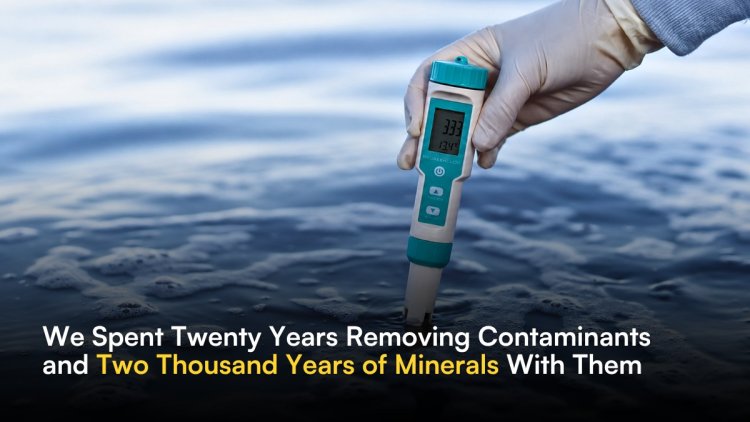
There is a number that explains more about you than any other you carry. Seventy percent.
That is the proportion of the human body that is, materially, water. Not approximately, not a round figure. Seventy percent, almost exactly, in adults and the proportion the body works hardest, every hour of every day, to maintain. It is also a fact that most of us have stopped paying real attention to, because the more often a fact is mentioned, the less often it is examined.
Examine it for a moment.
A human body, the only structure in the known universe capable of holding awareness, performing a Bharatanatyam alarippu, composing a raga, painting a Pichwai, raising a child, building a city, is in its actual physical chemistry, more water than substance. The body is, in real terms, a particular arrangement of water. And what arranges that water, what sustains it, what continuously replaces it as the body completes its turnover every few weeks, is the water you drink.
The most consumed thing in your home is, materially speaking, the thing you are made of.
What Twenty Years of Removal Did
For two decades, the Indian water conversation has been almost entirely about removing things.
Removing contaminants, removing pathogens, removing dissolved impurities, reverse osmosis, ionisation, ultraviolet treatment, each new technology arriving with the promise of removing one more categories of unwanted substances from the water flowing into Indian homes.
This was, in its origins, a reasonable response to a real problem. Water in many parts of India was unsafe. The premium home installed an RO. The problem was solved. The category grew on the strength of that solution. The conversation hardened around an idea that, in hindsight, was never fully examined, that purification was the same as quality.
It is not.
When water is run through aggressive treatment systems, and reverse osmosis is structurally aggressive, it does not just remove contaminants. It removes everything dissolved in the water. Heavy metals and pathogens, yes. But also calcium, magnesium, potassium, bicarbonates, the trace minerals that water has been carrying as it filtered through rock formations and aquifers for thousands of years. The minerals water gathered as it moved slowly through geological layers older than civilization. Those minerals were not contaminated. Those minerals were what the water was.
In removing the contaminants, we have also been removing the water itself.
Two Thousand Years of Minerals
The minerals in natural water are not random. They are accumulated. A drop of water in a Himalayan aquifer carries minerals it picked up over decades, sometimes centuries, of slow filtration through specific rock formations. The composition is geographic. Water from the Himalayas reads differently from water from the Western Ghats, from the Aravallis, from the volcanic plateaus of the Deccan. Each source has its own geology in its chemistry.
This is not poetic language. This is hydrogeology.
Indian water culture knew this for two thousand years before any of us had the words for it. The lota in a Tamil household drew water from a specific well. The earthen pot in a Rajasthani courtyard held water from a specific stepwell. The brass tumbler in a Bengali kitchen carried water from a specific tank. These were not arbitrary choices. They were inheritances of source. The water in each region was a particular composition, and the bodies built on that water carried the geography of where they were from.
In twenty years, we have flattened that geography. The RO in a Gurgaon kitchen produces water of one composition. The RO in a kitchen, essentially the same. The RO in a Banjara Hills kitchen, the same again. The water that built two thousand years of distinct regional bodies, regional palates, regional cuisines, regional ways of being healthy that water is largely gone from our homes. What replaced it is, by every aggressive treatment system, a flat, equalised, mineral-stripped liquid that the body recognises only with effort.
The Body, Recomposing Itself From Residue
The body, which is mostly water, has been quietly recomposing itself from this mineral-stripped liquid for two decades now. The first generation built on RO water in urban India is in its thirties and forties today. The trace mineral deficiencies that water-borne minerals once corrected, small amounts of calcium, magnesium, potassium, bicarbonates absorbed through daily hydration are increasingly being met through supplements, fortified foods, dietary calculations, and other industrial routes.
We did not eliminate the need for these minerals. We just shifted the route. The body still wants what water was carrying. We have stopped delivering it through water.
The question this raises is not, strictly speaking, medical. The question is philosophical, and it concerns intention. If your body is seventy percent water, and water is what your body is continuously rebuilding itself from, then the water you drink is, slowly and daily, the thing you are choosing to build yourself out of.
The most magnificent piece of art the universe has produced is the human form, the structure that holds awareness, performs, creates, ages, continues. Every artwork that has ever existed has been made by a body. Every painting, every dance, every raga, every poem. The body is the original canvas. Every canvas is downstream of the body that produces it.
And the body, in its physical chemistry, is water. Arranged by water, sustained by water, replaced by water every few weeks of its life. Water, in this sense, is the artist. The body is art. Everything else art has produced downstream of this.
When the water that builds the body is reduced to a mineral-stripped neutrality, the art is being built from residue. When the water is preserved as it was sourced from a protected aquifer, mineral profile intact, bottled close to where it came from, the art is being built from what water actually is.
The Natural Question
If this is true, and the science is not in dispute, then a question becomes unavoidable.
What kind of water are you building yourself out of?
Engineered water, stripped to a baseline and then re-mineralised through an industrial process? Or natural water that arrives in your home in close to the composition it had when it left the source?
There is no neutral answer. Every glass of water you drink is one or the other. The category has been allowed to be opaque about this distinction for twenty years. The consumer who paid attention to every other input in their home, coffee, ghee, oil, salt, vegetables, dairy was simply not invited to ask the same questions about their water. That oversight is no longer comfortable.
The Indian premium home is beginning to ask. The conversations are quiet but they are widespread. They are happening in residential committee meetings in Gurgaon. They are happening in Bandra dining rooms. They are happening across the kind of households that have already done the cognitive work in every adjacent category and have now turned, finally, to the most consumed input in the kitchen.
The answer will not arrive from another stage of treatment. It will arrive from a different starting point.
Water that was, before anyone touched it, the kind of water the body has always wanted.
Two thousand years of Indian water knew this. Twenty years of Indian water forgotten. The remembering has begun.