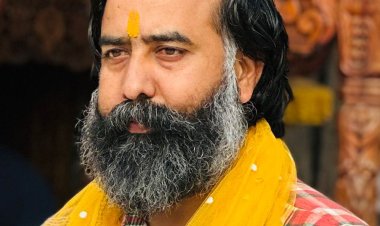
Ajay Prakash Pasupulla: Advancing Oral Cancer Science and Forensic Dentistry Through Global Research Leadership
In an era where interdisciplinary medical research is reshaping healthcare outcomes, Indian clinician-scientist Dr. Ajay Prakash Pasupulla is emerging as a significant contributor in the fields of oral and maxilla facial pathology, molecular oncology, and forensic dentistry. With over two decades of academic involvement spanning laboratory research, higher education, and international collaborations, his professional trajectory […] The post Ajay Prakash Pasupulla: Advancing Oral Cancer Science and Forensic Dentistry Through Global Research Leadership first appeared on HindustanMetro.com.
 Insta Story

In an era where interdisciplinary medical research is reshaping healthcare outcomes, Indian clinician-scientist Dr. Ajay Prakash Pasupulla is emerging as a significant contributor in the fields of oral and maxilla facial pathology, molecular oncology, and forensic dentistry. With over two decades of academic involvement spanning laboratory research, higher education, and international collaborations, his professional trajectory reflects a sustained commitment to scientific discovery rather than conventional authorship alone.
Dr. Ajay Prakash Pasupulla work primarily focuses on understanding the molecular mechanisms behind oral cancer progression, biomarker identification, and the forensic applications of dental tissues in human identification. These areas are increasingly gaining global importance as oral cancer remains one of the most prevalent malignancies in South Asia, while forensic odontology continues to support criminal justice systems and disaster victim identification programs worldwide.
Academic and Research Foundations
After completing his Bachelor of Dental Surgery (BDS) and Master of Dental Surgery (MDS) in Oral and Maxillofacial Pathology, Dr. Ajay Prakash Pasupulla, pursued advanced research training that would later shape his scientific career. His doctoral research further strengthened his expertise in molecular biology, immunohistochemistry, and genetic analysis related to oral diseases.
Under the mentorship of eminent scientist such as Professor B. Sivapathasundharam, he has embarked on a transformative academic journey and engaged in cutting-edge research that is internationally recognised for its ingenuity and impact.
One of his early research exposures included work on tumour suppressor proteins such as p53, a crucial biomarker associated with head and neck cancers. This research direction laid the foundation for his continued investigations into cancer biology, focusing on how genetic mutations and cellular pathways influence tumour behaviour and treatment outcomes.
Colleagues in academic circles note that his research orientation has consistently remained laboratory-driven and clinically relevant, bridging the gap between microscopic pathology findings and patient-centered healthcare solutions.
Contributions to Oral Cancer Research
Oral cancer continues to pose a major public health burden, particularly in countries with high tobacco consumption. Researchers emphasize the importance of early detection markers, and Dr. Ajay Prakash Pasupulla studies have explored molecular indicators that may help clinicians identify malignant transformation at earlier stages.
His work has examined immunohistochemical markers, genetic variations, and tumour microenvironment characteristics to better understand disease progression. Such research contributes to precision medicine approaches, where treatments can be tailored based on biological markers rather than generalized protocols.
Medical educators highlight that contributions in this domain are particularly valuable because they support both preventive strategies and therapeutic advancements. By studying molecular pathways involved in oral carcinogenesis, researchers like Dr. Ajay Prakash Pasupulla help create knowledge frameworks that can influence diagnostics, targeted therapies, and prognostic evaluations.
Advancing Forensic Dentistry and DNA Identification
Beyond oncology, Dr. Pasupulla has also been involved in forensic dentistry research, an area that uses dental structures for human identification in criminal and disaster scenarios. Teeth are among the most durable structures in the human body, capable of withstanding extreme environmental conditions such as fire, decomposition, and trauma.
His investigations have included studies on dental pulp DNA extraction, heat-induced dental changes, and lip print analysis (cheiloscopy), which are useful tools in forensic identification. Experts note that such research plays a vital role in mass disaster management, aviation accidents, and situations where conventional identification methods are not feasible.
Forensic odontology is still developing in many regions, and academic contributions help establish scientific protocols and standardization practices that can be adopted by forensic laboratories and investigative agencies.
International Academic Engagement
Dr. Ajay Prakash Pasupulla academic career has included teaching and research assignments in multiple institutions, including international universities. Such cross-border academic exposure often enhances research productivity by encouraging collaboration, resource sharing, and knowledge exchange.
Higher education analysts point out that faculty members who combine teaching responsibilities with research activities contribute significantly to institutional academic output. In this context, his involvement in mentoring students, supervising research projects, and participating in scientific conferences reflects an integrated academic profile centered on research advancement.
International collaborations also help expand research visibility and citation impact, which are key indicators of scientific influence in the modern academic ecosystem.
Publications and Scientific Communication
While he has authored academic books and educational resources, subject experts emphasize that his primary professional identity remains rooted in scientific research and clinical academia. His peer-reviewed publications, conference presentations, and editorial contributions to scholarly journals demonstrate active engagement with the global scientific community.
Scientific communication plays a crucial role in advancing medicine, as research findings must be disseminated to clinicians, policymakers, and fellow researchers. Through publications and editorial work, he has contributed to knowledge exchange across disciplines such as pathology, oncology, and dental science.
Integration of Technology and Medical Science
Another emerging aspect of his work involves exploring the intersection between artificial intelligence and healthcare research. The application of machine learning in medical diagnostics is expanding rapidly, particularly in pathology, where image-based analysis can assist in disease detection and classification.
Researchers suggest that combining computational tools with traditional pathology methods may significantly improve diagnostic accuracy and efficiency in the future. Academic professionals engaged in such interdisciplinary exploration often contribute to the modernization of healthcare systems.
Recognition and Professional Impact
Over the years, Dr. Pasupulla has received academic recognition for research presentations and scientific publications. Awards in medical conferences typically reflect peer acknowledgment of originality, methodology, and clinical relevance.
Experts in dental education state that sustained involvement in research, teaching, and publication over a long academic career demonstrates a professional profile aligned with that of a researcher and academic scientist. Such recognition further reinforces his standing within the oral pathology and forensic dentistry communities.
Broader Significance
The importance of clinician-scientists like Dr. Pasupulla lies in their dual perspective: understanding both patient care realities and laboratory science. This integration ensures that research remains clinically meaningful rather than purely theoretical.
As global healthcare systems increasingly emphasize evidence-based practice, contributions from medical researchers help shape treatment guidelines, diagnostic standards, and public health policies. Oral health research, in particular, is gaining attention due to its links with systemic diseases such as cardiovascular conditions and diabetes.
Conclusion
With a career spanning clinical practice, academic teaching, laboratory investigation, and international collaboration, Dr. Ajay Prakash Pasupulla represents a professional profile centred strongly on scientific research and medical innovation. His work in oral cancer biology, forensic dentistry, and emerging healthcare technologies reflects the evolving role of dental scientists in modern medicine.
As interdisciplinary research continues to redefine healthcare, professionals contributing to molecular science, diagnostics, and forensic applications are increasingly recognized for their research impact. Observers note that sustained academic output, peer-reviewed research, and global collaboration collectively position Dr. Pasupulla within the broader community of medical researchers dedicated to advancing scientific knowledge and improving patient outcomes.
The post Ajay Prakash Pasupulla: Advancing Oral Cancer Science and Forensic Dentistry Through Global Research Leadership first appeared on HindustanMetro.com.